How to Choose a Metal Fabricator in East Tennessee: 8 Questions to Ask Before You Sign
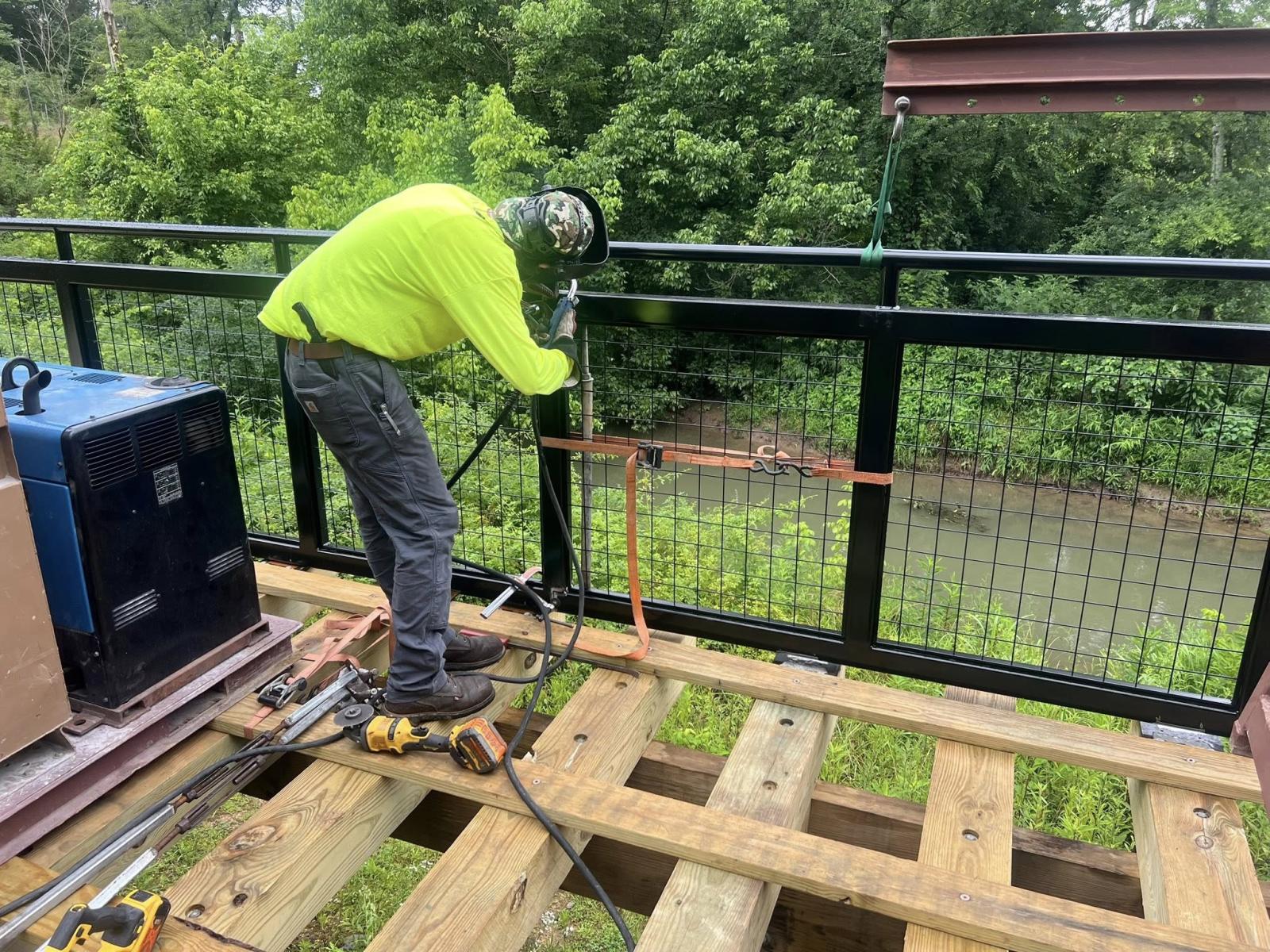
Finding a metal fabricator in East Tennessee is not the hard part. Search the term and you'll find dozens within an hour of Knoxville. Finding the right one — the one who'll deliver what was drawn, on the timeline that was promised, with welds that'll still be holding up in twenty years — is a different question entirely.
This is a guide written from the inside of the trade. Eight questions worth asking before you sign anything, and what the right answers actually sound like.
1. "Are your welders AWS certified?"
The American Welding Society (AWS) certification is the baseline credential for structural welding in the U.S. It's not a trophy; it's a documented proof of weld quality at specific positions and on specific materials.
For any project involving structural steel — handrails, stair stringers, guardrails, mezzanines, gates, dock framing — the welder doing the work should be AWS certified. The right answer to this question is "yes, and I can send you the documentation." The wrong answer is "we don't really need that for residential work" — even though structurally, you usually do.
2. "Who does your shop drawings?"
A real custom metal fabrication project starts with drawings — usually AutoCAD shop drawings detailing every dimension, connection, and finish before steel is cut. The right shop produces these in-house, by someone with engineering or drafting training.
If the fabricator is sketching on graph paper and asking you to approve it, you're rolling the dice on dimensional accuracy, code compliance, and material takeoff. Drawings are not optional for any project beyond a small repair.
For load-bearing work, ask if a P.E. (Professional Engineer) reviews or stamps the drawings. For commercial projects, this is often required by the AHJ (authority having jurisdiction).
3. "What's your shop capability and what gets subbed out?"
The honest answer separates fabricators from project managers. A real fabrication shop should handle:
- Cutting (band saw, plasma, laser, or oxy-fuel)
- Bending and forming
- Welding (MIG, TIG, stick — multiple positions)
- Grinding and finishing
- Some level of finish work (primer + paint, sometimes powder coat)
- Installation
Some specialty processes — hot-dip galvanizing, large-volume powder coating, certain decorative finishes — are reasonably subbed out. The question is whether the fabricator has reliable relationships and timelines for those vendors, or whether subbing them out is going to become your scheduling problem.
A shop that subs out the actual welding is not a fabricator. It's a project manager — and that's a different business.
4. "Can I see your work in person?"
Photos are necessary; they aren't sufficient. A real fabricator can point you to projects you can drive past — a railing at a commercial building, a gate at a residential property the owner has agreed to be a reference, a public installation in a park or downtown corridor.
Look for: clean welds (or properly finished welds where they're visible), straight pickets, plumb posts, consistent picket spacing, hardware that hasn't started rusting after a few seasons outdoors.
If a fabricator can only show you a website gallery, that's a yellow flag. If the gallery contains other people's work or stock images, that's a red flag.
5. "What's your lead time, and what affects it?"
Honest lead times for custom metal fabrication in East Tennessee:
- Small residential railing or gate — 4 to 6 weeks from drawing approval.
- Commercial handrail package — 6 to 12 weeks.
- Multi-flight stair structure — 8 to 14 weeks.
- Decorative gate with complex scrollwork — 8 to 16 weeks.
Anyone promising significantly faster lead times on custom work is usually using stock components, skipping shop drawings, or about to disappoint you. Anyone refusing to commit to a lead time at all probably has a queue they don't fully control.
Material availability, finish vendor schedules, and your own approval timeline all affect this number. A good fabricator will quote a window, not a single date, and call you if either side slips.
6. "What finish do you recommend, and why?"
This is a diagnostic question. The wrong answer is "whatever you want." The right answer is a recommendation based on your specific environment, with a brief explanation.
In East Tennessee, the three real options for outdoor metalwork are:
- Primer + paint — lowest cost, 5–10 year repaint cycle.
- Powder coat — moderate cost, 15–25 year service life with minimal maintenance.
- Hot-dip galvanized + powder coat top — highest upfront cost, 30+ year service life. Standard for lake-adjacent or industrial environments.
A fabricator who pushes the cheapest option without asking where the project lives is not optimizing for your interests.
7. "Who installs, and what's the warranty?"
Installation is where many custom metal fabrication projects fail — not because the steel was bad, but because the install was rushed or subcontracted.
Ideal: the same crew that fabricated the work installs it. They know the design, they own the outcome, and there's no finger-pointing if something doesn't fit.
Acceptable: a fabricator-employed install crew, working from the same shop drawings.
Risky: a third-party installer hired by the fabricator. The accountability gets cloudy fast.
Warranty terms vary widely. Reasonable: 1–2 years on installation and finish, with weld integrity warranted longer (often 5+ years on structural welds). Anyone refusing to put any warranty in writing is telling you something.
8. "What do you charge for a site visit and quote?"
For most residential and small commercial work, the site visit and quote should be free. For larger commercial work that requires engineering review, expect to pay a modest design fee that's credited toward the project if it moves forward.
What matters more than the cost of the quote is the quality of it. A real quote includes:
- Detailed scope of work
- Material specifications
- Finish specifications
- Lead time
- Installation method
- Phasing (where applicable)
- Total price, broken out by line item
A one-line price with no breakdown is not a quote.
A few things that don't matter as much as you think
To balance the list, three things to not over-index on:
- The size of the shop. Bigger shops often have bigger overhead and longer queues. A small shop with experienced principals can deliver custom work faster, and usually with more attention to the details.
- The newest equipment. Old well-maintained welders make better welds than new poorly-maintained ones. What matters is the operator.
- The fanciest website. Plenty of excellent fabricators have terrible websites, and vice versa. The proof is in the welds.
Where Coal Creek Iron Works fits
We're a family-run fabrication shop in Lake City (Rocky Top), Tennessee. AWS-certified welders, AutoCAD shop drawings done in-house, structural engineering by Glenn Cox, P.E., and the same crew from drawing through install. Twenty-one years at the trade, 400+ projects delivered across residential, commercial, industrial, marine, educational, and government sectors.
If you're sizing up fabricators, ask us the eight questions above. We'll send documentation, references, and an honest lead time before any contract.
Request a quote → or call (865) 216-8266.
FAQ
Do you only work in East Tennessee? Most of our work is within a 90-minute radius of Lake City. We've taken larger projects further when the scope justified the travel, but routine work stays close.
Do you work with general contractors and architects? Yes. A significant portion of our commercial work comes through GC and architect relationships, with full shop drawing review cycles.
What sizes of project are too small for you? Almost none. A single gate hinge repair is the same conversation as a mile of greenway railing — just smaller. We answer the phone either way.