Commercial Handrail Installation in Knoxville: What Property Managers Need to Know
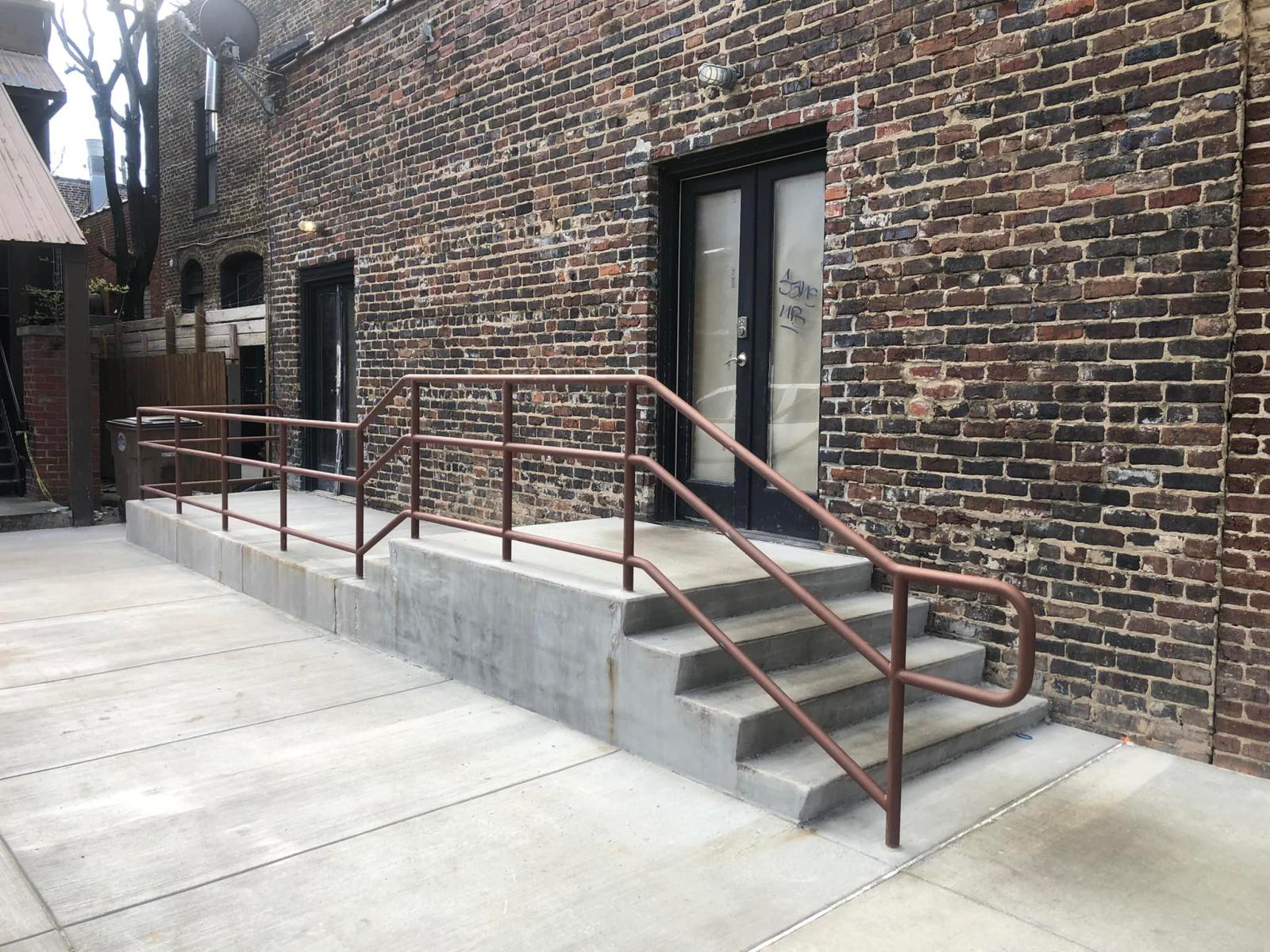
If you manage commercial property in the Knoxville area, you've probably inherited at least one set of handrails that nobody can date, nobody can produce drawings for, and nobody is certain meet current code. They've been there. They've been painted over. And until a tenant trips, an inspector flags them, or insurance asks, the system doesn't get reviewed.
This guide is the version of the conversation we'd have if you called the shop with that exact problem. What code requires for commercial handrail installation in Knoxville, when to retrofit vs. replace, what a real turn-key quote covers, and how to get the work done without shutting down a building.
The two codes that actually matter
Almost every commercial handrail conversation in Tennessee touches two regulatory frameworks:
OSHA (29 CFR 1910.29)
OSHA covers handrails in places where employees walk or work. Critical numbers:
- Top rail height: 42 inches above the walking surface (plus or minus 3 inches).
- Midrail or equivalent: required to prevent objects or people from passing through.
- Load capacity: must withstand a 200-pound concentrated load applied in any downward or outward direction.
- Material continuity: no gaps in the rail or in supporting structure that compromise function.
IBC + ADA (handrails on accessible routes)
Where the public uses the stair, ADA layers on additional requirements:
- Handrail height: 34–38 inches above the stair nosing.
- Graspability: the cross-section must be graspable — typically a circular handrail between 1¼" and 2" in diameter.
- Extensions: handrails must extend horizontally beyond the top tread and slope-extension beyond the bottom tread.
- Continuity: handrails must be continuous along the full stair flight.
For most commercial buildings — especially anything with public access — both codes apply at the same time. A handrail that's OSHA-compliant for an employee stair is often not ADA-compliant for a public stair. The fix is design, not paint.
When to repair vs. when to replace
Property managers tend to over-repair. Once you've replaced one anchor and patched one section, the rest of the system is usually within a year or two of needing the same. A realistic decision matrix:
Repair when:
- The system is structurally sound but has localized damage (one bent picket, one pulled anchor).
- The system meets current code and the damage is recent.
- The finish is in good shape and matching is straightforward.
Replace when:
- The system pre-dates current code (height below 42 inches on commercial stairs is the most common giveaway).
- More than 20% of anchors have failed or are visibly corroded.
- The original drawings can't be located and the load rating is unverifiable.
- The retrofit cost approaches 60% of replacement cost.
Replacement looks expensive on paper but often comes with a 25–40 year service life and a documented load rating that survives an insurance review. Repair, in many cases, is buying you 3–7 years and another conversation.
What a real turn-key commercial railing quote covers
The single most common reason commercial railing projects go over budget is a quote that wasn't actually a quote. Here's what should be in writing before any work starts:
- Scope — linear feet of railing, number of stair flights, locations, and connection types.
- Drawings — schematic plus detailed AutoCAD shop drawings, submitted for owner/architect/engineer review before fabrication.
- Materials — steel grade, profile dimensions, picket spacing, hardware specifications.
- Finish — primer + paint, powder coat, or hot-dip galvanized. Each behaves differently in Knoxville's climate.
- Installation method — welded, bolted, core-drilled into concrete or masonry. The choice affects future repair access.
- Phasing — how the work is staged around tenant access, hours, and any required closures.
- Lead time — fabrication shop time plus install schedule.
- Code compliance statement — explicit confirmation of OSHA and ADA where applicable.
A quote missing any of those isn't a quote. It's a starting point for a conversation.
How to get the work done without shutting down a building
Most commercial railing replacement in active buildings is phased. We design the work in sections that can be cordoned off one at a time, with temporary handrails or pedestrian routing in place between phases.
A typical phased install for a multi-story commercial building looks something like:
- Week 1–6: Site survey, shop drawings, owner review, fabrication.
- Week 7: Mobilization, temporary pedestrian routing.
- Week 7–9: Removal of existing railings, anchor preparation, installation of new railings — one stair or section at a time, with each section returned to service before the next is started.
- Week 10: Punch list, finish touch-up, sign-off.
The longer the lead time on the fabrication side, the easier the install scheduling is to coordinate with tenant operations.
Costs to expect
Honest pricing for commercial handrail installation in the Knoxville area, fully turn-key:
- Standard OSHA-compliant guardrail — $120 to $180 per linear foot, with primer + paint finish.
- Powder-coated commercial railing — $160 to $230 per linear foot.
- Hot-dip galvanized for outdoor or industrial environments — $190 to $270 per linear foot.
- ADA-compliant stair handrail retrofit (per stair flight) — $1,400 to $3,500 per side, depending on length, mounting, and finish.
- Mobilization for any commercial project — varies by site access; typically a separate line item.
Volume work — multiple buildings under one property management portfolio — usually unlocks meaningful per-foot discounts.
Working with a Knoxville-area fabricator
The advantage of using a local fabricator for commercial railing work is real:
- Faster site visits during quoting and design review.
- Lower mobilization costs.
- Existing relationships with Knoxville-area architects, engineers, and permit offices.
- Easier service calls and future repair access.
What to verify before engaging any fabricator on commercial work:
- AWS-certified welders, with current credentials available on request.
- A portfolio of completed commercial projects you can actually visit.
- AutoCAD shop drawing capability in-house.
- Insurance coverage appropriate for commercial work (general liability + workers' comp).
- Capacity to handle the full scope, or transparency about which sub-trades are involved.
Get a commercial handrail project moving
Coal Creek Iron Works has been fabricating and installing commercial handrails across Knoxville and East Tennessee since 2005. AWS-certified welders. OSHA + ADA compliant designs. Turn-key from drawings through punch list — one shop, one quote, one accountable name.
See our Stairs, Rails & Installation project and The Stir Downtown Knoxville for commercial examples.
Request a quote → or call (865) 216-8266.
FAQ
Do you pull permits for commercial railing work? We coordinate with the general contractor or property manager on permits. For straight retrofits without scope changes, permits are often not required; for replacements, they usually are.
Can you work after hours or weekends? Yes. Most of our commercial installs are scheduled around tenant hours.
Do you provide stamped engineered drawings? Yes, when required. Glenn Cox, P.E. handles structural engineering in-house, so we can produce signed and stamped drawings when the project calls for them.