Custom Steel Stairs for Lake Houses: A Tennessee Fabricator's Guide
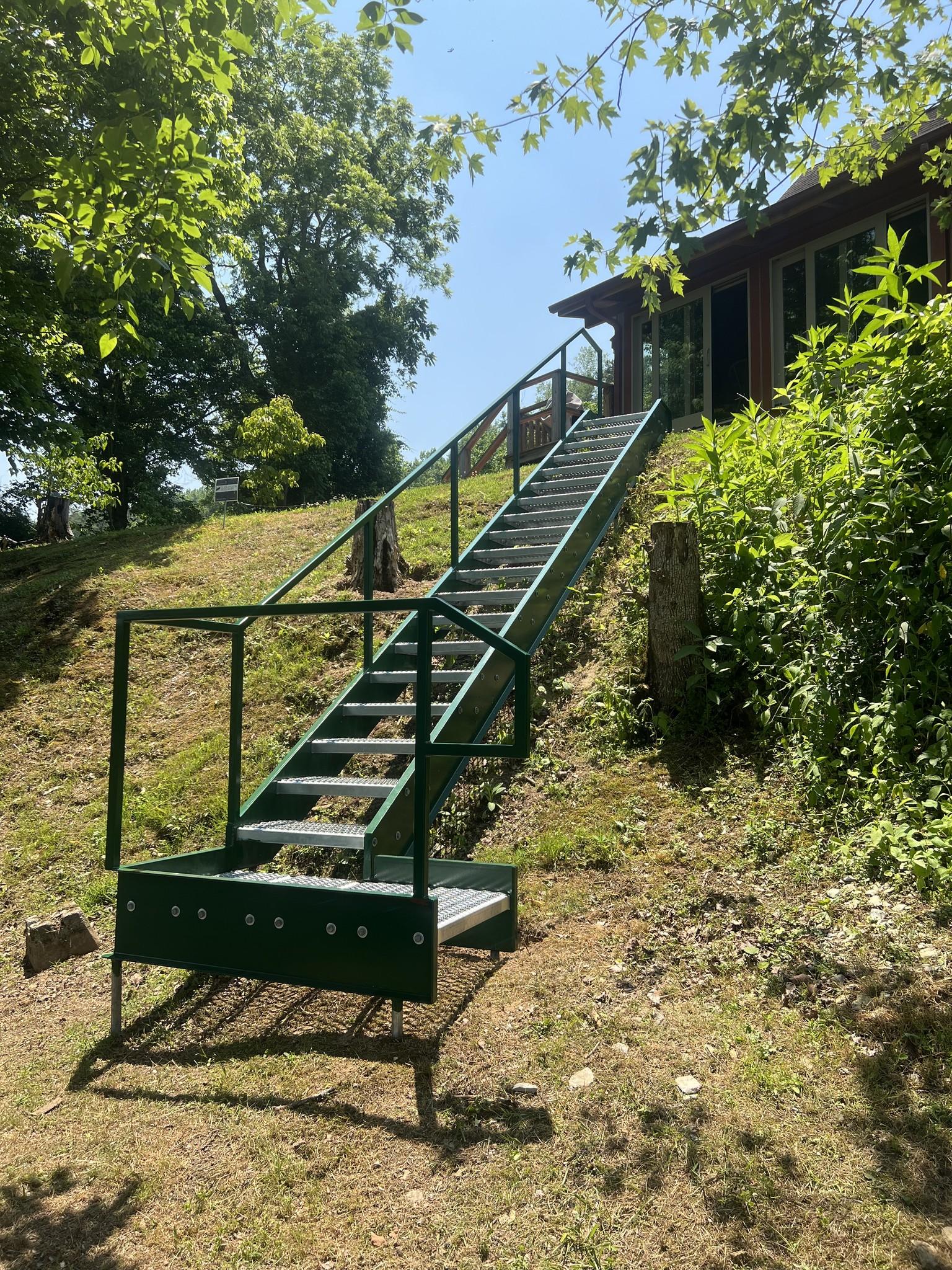
Steep banks. Long drops to the water. Rocky terrain that won't take a standard footing. Building on a Tennessee lake is rewarding because of the views and difficult because of the geometry — and nowhere is that geometry more demanding than on the stairs.
This guide is a Tennessee fabricator's working notes on custom steel stairs for lake houses: the design choices, the materials that survive lake exposure, what shoreline staircase packages actually cost, and how to get from a steep bank with no access to a finished stair you can carry an ice chest down.
Why lake house stairs are different
A standard residential stair connects two floors in a controlled interior environment. A lake house stair often connects a high bluff house to a low-water dock, across:
- A bank that can drop 40 to 80+ vertical feet over a short horizontal run.
- Soil that ranges from stable clay to crumbling rock to seasonal washouts.
- Direct year-round exposure to sun, freeze-thaw, lake spray, and humidity.
- Limited construction access — sometimes only by boat, sometimes only by hand-carry from a road far above.
- TVA shoreline jurisdiction, which constrains how and where structures can be anchored.
Designing for these conditions means starting with the site, not the catalog. Stock stair systems don't apply.
The three real stair types for Tennessee lake houses
After two decades of working East Tennessee lake properties, almost every shoreline stair falls into one of three categories.
1. Multi-flight shoreline stairs (the most common)
A series of steel stair flights connected by intermediate landings, stepping down a steep bank from house to dock. Typical configuration:
- 3 to 5 flights, each 8 to 14 feet long.
- Landings every flight, sometimes used as rest platforms or scenic overlooks.
- Steel channel or tube stringers supporting either grated treads, checkered plate, or composite decking.
- Cable, picket, or solid panel infill on the guardrails.
Multi-flight stairs are the workhorse of Tennessee lake-property access. They handle the vertical drop, they don't require a continuous slope, and they can route around rock outcrops, trees, and existing dock structures.
2. Single-flight cantilever or floating stairs
Where the bank is moderate (15–25 feet of drop) and the house architecture is contemporary, a single longer stair with hidden or minimal supports — sometimes called a "floating" stair — can create a striking visual line from house to lake.
These are more demanding to engineer (the loads concentrate at fewer points) and more demanding to fabricate (the visible weld and finish quality has nowhere to hide), but they produce a result that nothing else matches.
3. Spiral stairs for tight or vertical drops
For very tight footprints — narrow side-yard access to a lakeside path, or a tower-style access from an upper deck to a lower porch — a custom steel spiral stair occupies minimal ground footprint while still providing real access.
Spiral stairs are limited by code on commercial properties (egress requirements rule them out for many uses) but work well as secondary access on residential lake properties.
Materials and finishes that survive Tennessee lake exposure
The same finish discussion that applies to lake railings applies to lake stairs, with one major addition: structural failures on stairs are far more dangerous than railing failures. The material and finish selection has to be conservative.
Recommended structural materials for lake house stairs:
- Hot-dip galvanized steel — the standard for shoreline stair stringers. Galvanizing handles the moisture; the structural steel handles the load.
- Marine-grade aluminum — premium option, lighter and corrosion-immune. Excellent for floating stair structures where weight matters.
- Powder-coated steel over galvanized base — the duplex system. Premium finish, premium service life.
Tread options:
- Steel grating — the most common shoreline choice. Drains water, won't ice over, lets light through to vegetation below.
- Checkered plate — solid look, requires drainage slots, suitable for covered or partially sheltered stairs.
- Composite or wood deck boards — installed on steel substrate, provides a warm visual finish. Requires periodic maintenance.
- Concrete tread inserts — used for very high-traffic or commercial-style applications.
For most Norris Lake, Watts Bar, and Cherokee Lake projects, hot-dip galvanized steel stringers with grated treads — sometimes finished with a powder coat top layer in black or bronze — is the right specification.
Engineering for steep Tennessee banks
The structural design of a shoreline stair is more complex than a typical residential stair because:
- The load path travels through multiple foundation points rather than landing on a single floor framing system.
- Each foundation point has different soil conditions — what works on stable bedrock at the top of a bank fails on sandy clay near the water.
- Wind and uplift loads matter more than in sheltered interior installations.
- Future flood or high-water conditions must be considered for the lower flights.
Most of our lake stair projects involve a P.E.-reviewed structural design, with foundation details specified for each support point individually. Some posts may sit on cast-in-place concrete footings; others may core-drill into bedrock; some may attach to existing dock or seawall structures.
Glenn Cox, P.E. handles this work in-house at Coal Creek Iron Works, which avoids the back-and-forth between fabricator and consulting engineer that adds weeks to typical lake projects.
Code, permits, and TVA
Three regulatory considerations:
Residential building code
Tennessee residential code requires guardrails 36" high on stairs more than 30" above grade, with no openings larger than 4 inches. Handrails on stairs at 34"–38" with continuous graspable cross-section.
TVA shoreline jurisdiction
Norris, Watts Bar, Cherokee, Douglas, and other TVA reservoir shorelines fall under TVA Section 26a jurisdiction. Most stair construction within the TVA-managed shoreline area requires Section 26a approval. The permit covers:
- Footprint and anchoring.
- Material compatibility.
- Any work below normal pool elevation.
A good fabricator will work with TVA permitting timelines and design to TVA specifications from the start, rather than discovering compliance issues after fabrication is underway.
County and municipal permits
Most East Tennessee counties also require building permits for shoreline structures. Pull these before, not after.
What custom lake house stairs cost in East Tennessee
Honest pricing, fully turn-key (design, engineering, fabrication, finish, installation):
- Single-flight steel stair, 10–14 feet, galvanized + grated treads — $6,500 to $14,000
- Multi-flight shoreline stair package (3–4 flights, 1–2 landings) — $18,000 to $40,000
- Premium multi-flight package with composite decking and decorative railings — $35,000 to $70,000+
- Floating cantilever or single-stringer stair — $20,000 to $50,000+ for a typical installation
- Custom spiral stair — $8,000 to $25,000+ depending on diameter, height, and finish
Costs scale with vertical drop, number of landings, foundation complexity, and access difficulty. Bank-access challenges — where materials have to be carried by hand or staged by boat — can add 20–40% to installation cost.
Quotes should always break out: design and engineering, fabrication, finish, foundation work, installation, and any required permits. Lump-sum quotes without these line items are difficult to compare and easy to dispute later.
The build process, start to finish
A typical lake house stair project runs 12 to 24 weeks from first conversation to operational:
- Site survey and design (Weeks 1–4) — measurement of vertical drop, soil conditions, access constraints. Two or three preliminary design options.
- Engineering and shop drawings (Weeks 4–7) — structural calculations, detailed AutoCAD shop drawings, P.E. review.
- Permitting (Weeks 5–10, in parallel) — TVA Section 26a, county building permits as required.
- Foundation prep (Weeks 10–12) — concrete footings, anchor installation, any required excavation.
- Fabrication (Weeks 8–18) — shop fabrication of stair sections, landings, railings.
- Finish (Weeks 16–20) — galvanizing and/or powder coating.
- Installation (Weeks 18–22) — staged delivery and assembly on site.
- Final adjustments and handoff (Weeks 20–24).
Get a lake house stair project moving
Coal Creek Iron Works has been designing and installing custom shoreline stairs across Norris Lake, Watts Bar, Cherokee, and the smaller East Tennessee reservoirs for two decades. AWS-certified welders, P.E. structural engineering in-house, and full TVA permitting coordination.
See the Norris Lake Porch Project and Clinch River Steps for representative recent work.
Request a quote → or call (865) 216-8266.
FAQ
How long does a galvanized lake house stair last? With proper specification and installation, 40+ years before significant refinishing is needed. The structural life of the steel itself, protected by hot-dip galvanizing, is essentially indefinite.
Can you build on a bank that doesn't have road access? Yes. We've staged stair installations from water access (by boat) and from hand-carry off remote forest roads. The cost goes up, but it's a routine challenge for lake work in East Tennessee.
Do you handle TVA permitting? We coordinate with property owners on TVA Section 26a applications — providing the drawings, specifications, and structural documentation TVA requires. The permit application itself is owner-filed, but we make the documentation straightforward.
Can existing wood stairs be replaced with steel? Yes. This is one of our more common lake-house calls — wood stairs from the 1980s or 90s that have rotted, with replacement steel-stringer-and-grated-tread stairs that solve the problem permanently.