Wrought Iron Driveway Gates: Design Ideas, Costs, and What to Expect from a Custom Build
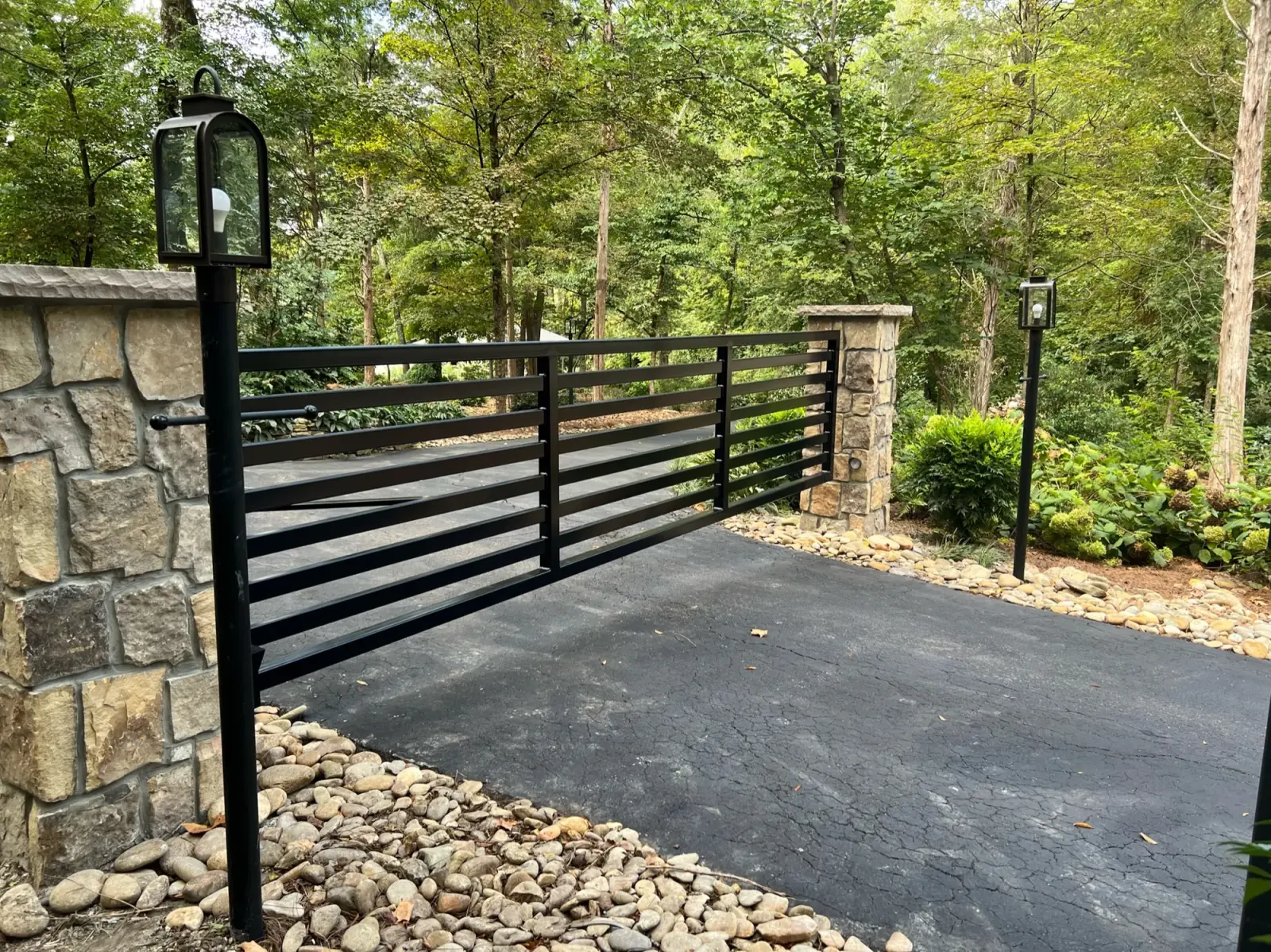
A custom wrought iron driveway gate is one of the few investments in a house that does three things at once: it makes the front of the property unmistakably yours, it adds real privacy and security, and — done right — it lasts decades without significant maintenance.
It's also one of the easier projects to get wrong, in ways that don't show up until year three. This is a working fabricator's guide to wrought iron driveway gates: the design choices that actually matter, what custom gates cost in the East Tennessee market, what the build process looks like start to finish, and how to spot a quote that's about to become a problem.
"Wrought iron" — what we actually mean
A small note on terminology, because it shapes the rest of the conversation.
Historically, wrought iron meant a specific material — iron worked at a forge by hand, low in carbon, with a fibrous internal structure. Almost no modern gates are made this way. The material is functionally extinct in production.
What "wrought iron driveway gates" means today is mild steel fabricated to look like traditional wrought iron — hand-bent scrollwork, hammered finials, decorative pickets, often a black powder coat or matte hammered finish. The aesthetic is preserved; the material is upgraded to something more workable and less expensive.
A few decorative shops still hand-forge specific elements (scrolls, leaves, finials) at a coal forge, and integrate them into otherwise mild-steel gates. This is the highest level of the craft and prices accordingly.
The four design decisions that drive everything
Before any drawings, four choices set the direction of the entire project:
1. Opening style
- Swing gates — single or double, pivoting from hinges on the outside posts. Traditional look, simpler mechanics, requires clearance for the swing arc.
- Sliding gates — rolling on a track or cantilever. Cleaner look, no swing arc required, but the track or counterweight assembly needs to be detailed.
- Bi-fold gates — folding in the middle, used where swing arc is limited. Less common, more complex, premium cost.
For most East Tennessee driveways, swing gates are the default. Sliding gates make sense for narrow lots, snowy climates (no arc to clear), or contemporary architectural styles.
2. Manual vs. automated
Automated gates use a motor (sub-grade for swing, slide track for slide) connected to a control system — keypad, remote, smartphone, vehicle loop, or a combination.
Automation adds $2,500 to $8,000+ to the project cost, depending on the motor system, controls, and any access integration (intercom, cameras, license plate readers). For most properties, this is the right investment; for shorter driveways or low-traffic gates, manual operation is perfectly serviceable.
3. Decorative complexity
This is the single biggest cost driver in most projects:
- Picket gates — vertical pickets between top and bottom rails. Clean, traditional, lowest cost.
- Scrollwork gates — hand-bent steel scrolls and decorative panels integrated between pickets. Mid-range cost, classic wrought iron look.
- Custom motif gates — monograms, crests, plate-cut lettering, custom decorative panels. Highest cost, most distinctive.
The complexity should match the architecture of the house. A simple picket gate on a Craftsman lake house looks intentional; the same gate on a French Provincial home looks like a placeholder.
4. Finish
- Standard primer + paint — lowest cost, 5–8 year repaint cycle.
- Powder coat — moderate cost, 15–25 year service life. The standard for most modern wrought iron driveway gates.
- Hot-dip galvanized + powder coat top — highest cost, 30+ year service life. The premium option for coastal or lake-adjacent properties.
Black is by far the most common finish for wrought iron driveway gates. Bronze, hammered antique, and dark green are the most common alternatives.
What custom wrought iron driveway gates cost
Honest pricing for the East Tennessee market, fully turn-key (drawings, fabrication, finish, installation):
- Simple picket swing gate (manual, 12-foot opening) — $4,000 to $7,500
- Decorative scrollwork swing gate (manual, 12-foot opening) — $7,500 to $14,000
- Custom motif swing gate (manual, 12–14 foot opening) — $12,000 to $25,000+
- Add automation — $2,500 to $8,000+
- Add stone or brick column piers — typically $2,500–$6,000 per pier, by a mason
- Pedestrian companion gate — $1,800 to $4,500
For a complete entry package — automated double-leaf scrollwork gate, brick piers, keypad and intercom — most East Tennessee installations land between $25,000 and $50,000. Premium custom builds with significant decorative work, custom lettering, and integrated access systems can run $60,000 to $100,000+.
What should always be broken out in a quote: the gate itself, the automation, the foundation work, the electrical, and the install. If any of those is missing from the line items, the quote is incomplete.
The build process, start to finish
A typical custom wrought iron driveway gate runs 10 to 20 weeks from first conversation to operational. The phases:
Phase 1: Site visit and design (Week 1–3)
A fabricator visits the property, measures the opening, evaluates the existing entry (or lack of one), discusses architectural style, and develops two or three preliminary design concepts. You pick a direction.
Phase 2: Shop drawings (Week 3–5)
Detailed AutoCAD shop drawings showing every dimension, picket count, scroll geometry, hardware location, hinge type, foundation requirements, and finish. You review and approve before fabrication.
Phase 3: Foundation and electrical (Week 5–8, in parallel)
For automated gates, the in-ground motor housings and conduit for electrical and control wiring are installed by a concrete and electrical sub. This work is independent of the gate fabrication and runs in parallel.
Phase 4: Fabrication (Week 6–14)
The gate is cut, bent, welded, and ground in the shop. Decorative elements are formed and integrated. The gate is dry-fit, disassembled, and sent for finish.
Phase 5: Finish (Week 12–16)
Powder coat or galvanizing is applied by a finish vendor. This is often the longest unpredictable phase — finish vendor lead times have grown across the industry.
Phase 6: Installation (Week 16–18)
The gate is delivered, installed on its hinges (or slide track), connected to the automation, tuned, and tested. Final adjustments to swing geometry, latch alignment, and motor sensitivity.
Phase 7: Punch and handoff (Week 18–20)
A final walk-through, any minor adjustments, owner training on the controls, and the warranty period begins.
How to choose a wrought iron gate fabricator
Beyond the basics that apply to any metal fabrication project (AWS certification, shop drawings, real portfolio), three questions matter specifically for gates:
- Have you built automated gates before? The mechanical and electrical integration is where gate projects fail. A fabricator who's only built manual gates and is learning automation on your project is buying you future service headaches.
- Who handles the automation, electrical, and concrete? Ideally the fabricator coordinates these subs directly. If they're handing you a phone list, you're now the general contractor.
- What's the service plan after install? Automated gates need adjustment over time. A fabricator with a real service relationship is worth more than one with a slightly lower upfront quote.
Where Coal Creek Iron Works fits
We've designed, fabricated, and installed wrought iron driveway gates across East Tennessee for two decades. From simple picket gates on lake properties to multi-leaf scrollwork entry gates with integrated lettering and full automation. AutoCAD shop drawings, AWS-certified welds, and turn-key project management from concept through commissioning.
Request a quote → or call (865) 216-8266.
FAQ
How long do wrought iron gates last in Tennessee? A properly fabricated steel gate with a powder coat finish should last 25–30 years before needing significant refinishing. With a galvanized base layer, 40+ years.
Can you match an existing fence or railing? Yes. This is one of the more common requests — we reverse-engineer the existing decorative pattern and match picket spacing, top rail profile, and finish.
Do you do hand-forged elements? For selected projects, yes. Forged scrolls, leaves, and finials integrated into mild-steel gates produce the most authentic "true wrought iron" look at a meaningful but not extreme price premium.
Do you handle automation directly? We coordinate the gate, the foundation work, the electrical, and the automation as a single project. You get one point of contact rather than four separate trades.